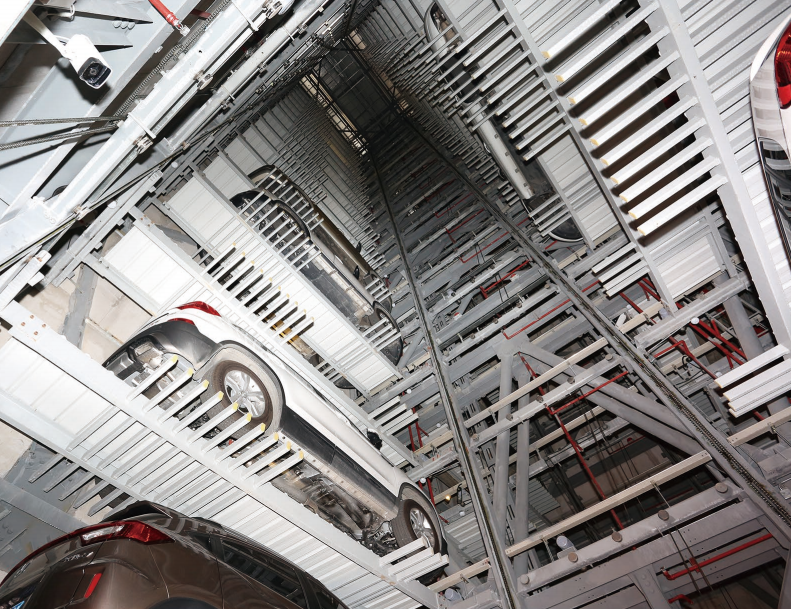
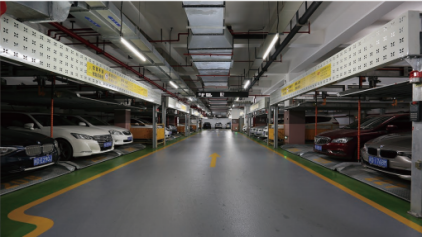
With the rapid development of the economy, the number of privately owned cars in China has maintained a growing trend year by year. However, most cities in China did not reserve sufficient parking spaces during their planning, resulting in a huge gap between the growth rate of parking spaces and that of car ownership. This has made the difficulty of parking an urgent problem to be solved. To address this issue, parking more cars in the same parking area has become the optimal solution at present, and based on this, stereo garages have become a topic of great concern. Stereo garages can utilize the vertical space above the same area to park more cars.
The Development History of Stereo Garages
When it comes to the development process of stereo garages, as early as the 1930s, the automobile manufacturing industry in the United States was already the world's largest. Along with this fact, the United States mechanized parking lots using stacker cranes and created the world's first lifting-type stereo garage. From the 1950s to the 1960s, Japan introduced technologies from Western Europe. Restricted by the scarcity of its land area, stereo garages quickly became popular in Japan. By the end of the 1960s, only Tokyo had built 40 various types of stereo parking lots.
In the 21st century, with the continuous advancement of science and technology, stereo garages have also been constantly updated and upgraded. In order to better solve the problem of difficult parking, we are committed to continuously optimizing the stereo garage system and striving to make stereo garages more popular.
Working Principle
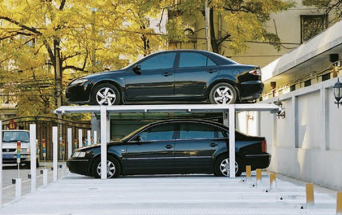
The equipment is arranged in two floors and multiple columns, and a translational empty space is set on the first floor of each equipment partition. The equipment realizes car storage and retrieval through the lifting movement of the car-carrying plates on the second floor and the translational movement of the car-carrying plates on the first floor. Cars can be directly stored in or retrieved from the parking spaces on the first floor; when a parking space on the second floor needs to be used for car storage or retrieval, the corresponding car-carrying plate on the first floor moves one parking space to the side, leaving the translational empty space directly below the car-carrying plate on the second floor where the car is to be stored or retrieved. Then, the car-carrying plate on the second floor descends to the ground to complete the car storage or retrieval process.
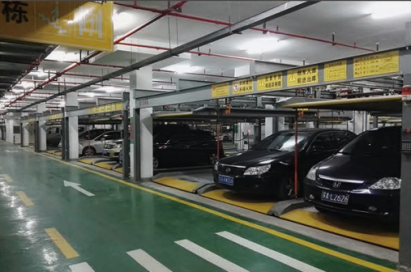
Technical Features of the Equipment
Firstly, with the PLC control system as the core, it is clear that the system receives input signals through optical limit switches, electrical sensors, and touch screens. It integrates the operation of motors, the control of lateral movement, as well as the execution of relays and contactors, and is equipped with an electronic display screen for status presentation, so as to realize the accurate storage and retrieval of cars. At the same time, relying on safety functions such as anti-falling protection, protection against people or vehicles straying into the working area, early warning for overlong vehicles, overcurrent power-off self-locking, and emergency braking, the stable operation of the system is ensured.
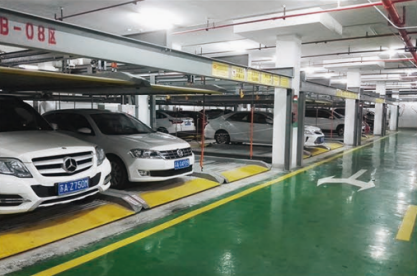
This equipment has prominent advantages: it can efficiently utilize space to increase the number of parked cars, and has low manufacturing and maintenance costs; it operates stably with low noise and enables convenient car storage and retrieval. The operation methods can be selected from button-type, touch-screen type, or card-swiping type. In addition, the number of columns can be reasonably arranged according to the user's needs, making it suitable for various types of sites.