How to Choose the Right Ultrafine Ball Mill for Your Industry?
Choosing the right Ultrafine Ball Mill is crucial for various industries. A recent report from Market Research Future estimates that the ultrafine milling market will reach USD 6 billion by 2025, driven by growing demand in sectors like pharmaceuticals, chemicals, and food processing. This highlights the importance of selecting the right equipment for efficiency and quality.
Dr. Jane Thompson, a renowned expert in the ultrafine milling sector, states, "The choice of an Ultrafine Ball Mill can significantly impact product quality and manufacturing costs." Her insights emphasize careful consideration of size, capacity, and application when making a selection. In industries that rely on ultra-fine materials, the stakes are high. A poor choice can lead to inefficiencies and increased costs.
Understanding your specific needs is essential. Different materials require different milling strategies. The subtle nuances between models may not initially seem significant, yet they can influence the final product. Thorough research and consultation with industry experts can help navigate these challenges effectively.

Understanding the Basics of Ultrafine Ball Mills
Ultrafine ball mills are essential in various industries for achieving fine particle sizes. Understanding their fundamentals is crucial for effective selection. These mills can grind materials down to sub-micron levels. Reports show that particle size significantly affects the performance of materials in sectors like pharmaceuticals and chemicals.
The operational principles of ultrafine ball mills involve a combination of impact, shear, and abrasion forces. The rotation speed and ball-to-powder ratio are critical parameters. A recent industry analysis indicates that optimizing these factors can enhance particle size distribution efficiency up to 30%. Many users still struggle with balancing these variables, leading to suboptimal results.
Innovations in design and technology are ongoing. Some mills now incorporate advanced monitoring systems for better control. However, not all features add value; some may complicate operations unnecessarily. Cost considerations also play a role. Investing in high-end models may not always yield noticeable improvements in output. Understanding these trade-offs can lead to better decision-making in the long run.
Ultrafine Ball Mill Selection: Key Factors Considered by Industries
Identifying Your Industry-Specific Requirements
When selecting an ultrafine ball mill, it’s crucial to align your choice with industry-specific requirements. Different sectors need varying specifications based on the materials they process. For example, the pharmaceutical industry often demands precision and contamination-free grinding. A report by the International Journal of Pharmaceutics highlighted that 70% of drug formulations require particle sizes under 10 micrometers. This basic requirement directly influences the mill's engineering and design.
Understanding the properties of the materials you work with is essential. Soft materials might not need extensive force, while hard minerals may require a more robust system. The milling process can also affect chemical stability. In many cases, users overlook the significance of temperature control during milling. Keeping an optimal temperature can prevent chemical reactions that may alter the properties of sensitive substances.
Tips: Consider the operational footprint of the mill. Compact designs can save space without compromising performance. Additionally, evaluate ease of maintenance, as this impacts long-term operational efficiency. Finally, user feedback on various mill types can provide valuable insights. Engage with industry forums to learn from real experiences. Balancing performance with your specific needs will lead to more effective outcomes.
Evaluating Key Features of Ultrafine Ball Mills
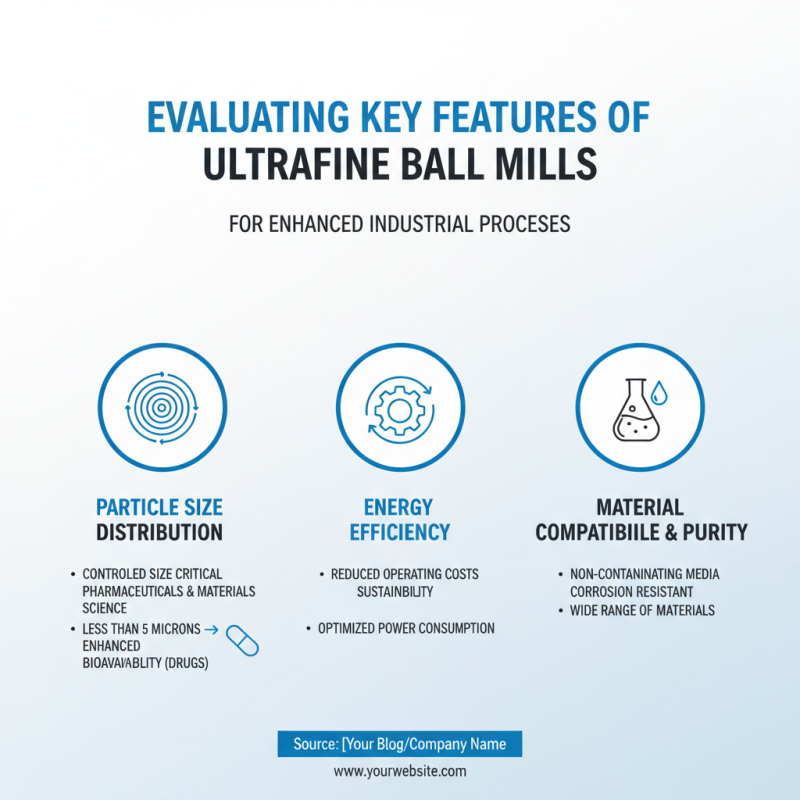
When selecting an ultrafine ball mill for your industry, it is vital to evaluate several key features. First, consider the particle size distribution. A controlled size is essential for processes in pharmaceuticals and materials science. Studies show that a particle size of less than 5 microns can enhance bioavailability, particularly in drug formulations.
Next, assess the milling efficiency. An efficient mill can achieve better results with less energy consumption. According to industry data, the energy consumption of ultrafine ball mills can vary significantly. Some reports indicate that high-performing models can reduce energy use by up to 30% compared to older equipment. Pay attention to the milling media as well; different materials can affect the quality of the end product.
Also, look at operational costs over time. The initial investment is only part of the equation. Maintenance costs and downtime should be evaluated critically. Ultrafine mills can incur high wear, leading to replacement needs. Therefore, it’s essential to choose a mill that combines durability with performance. While manufacturers provide specifications, real-world performance may vary, demanding careful monitoring and adjustment.
Comparing Popular Ultrafine Ball Mill Brands and Models
Choosing the right ultrafine ball mill requires careful consideration. Many brands offer various models, each with specific features. It is essential to understand the unique needs of your industry. For instance, a pharmaceutical manufacturer may require stringent particle size control, while a food processing plant might prioritize efficiency and hygiene.
Examining popular models reveals key differences. Some are designed for high throughput, while others focus on precision grinding. Various motor types and grinding materials impact performance. It's vital to analyze how these factors align with production goals. Research into industry benchmarks can guide effective comparisons.
Beyond performance metrics, consider customer support and maintenance options. Often, the best equipment comes with reliable warranties. Accessibility to training resources can also enhance operational efficiency. Reflect on the long-term implications of your choice. Investing time in research can pay off in the future. A well-informed decision builds trust within your supply chain. Make sure to evaluate how each model can adapt to changing industry demands.
How to Choose the Right Ultrafine Ball Mill for Your Industry? - Comparing Popular Ultrafine Ball Mill Brands and Models
| Model |
Grinding Capacity (kg/h) |
Particle Size (µm) |
Power Consumption (kW) |
Dimensions (mm) |
| Model A |
300 |
5 |
30 |
1200 x 800 x 1000 |
| Model B |
400 |
10 |
40 |
1500 x 900 x 1300 |
| Model C |
500 |
15 |
50 |
1600 x 950 x 1400 |
| Model D |
250 |
8 |
25 |
1100 x 750 x 950 |
| Model E |
600 |
12 |
60 |
1700 x 1000 x 1500 |
Making the Final Decision: Cost vs. Performance
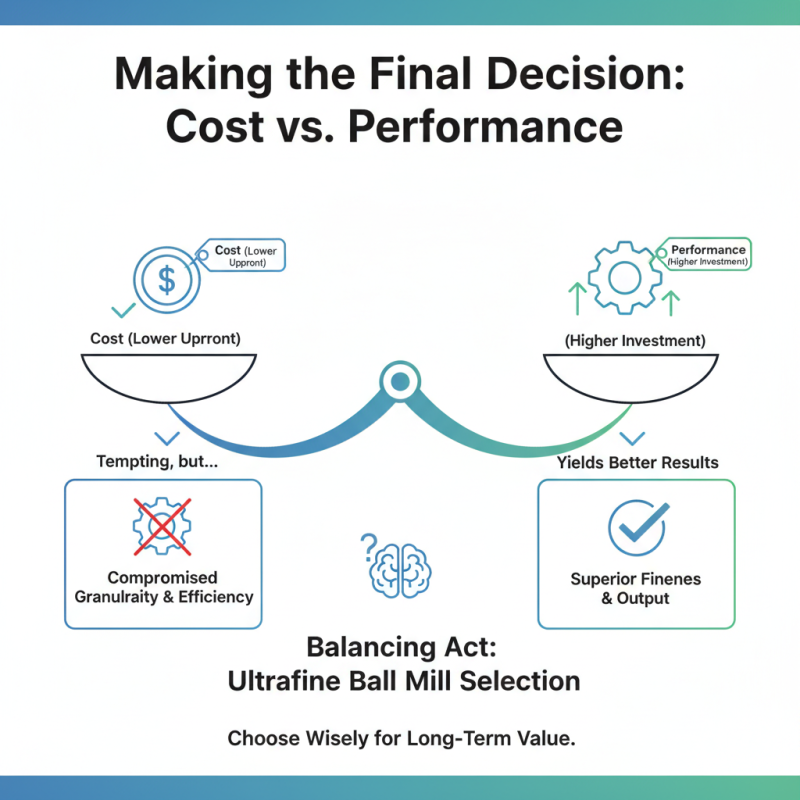
Choosing the right ultrafine ball mill involves a careful balancing act between cost and performance. Industry professionals often find themselves weighing their budget against the mill's capabilities. A cheaper option may seem enticing, but it might compromise the granularity and efficiency you need. Investing in high-performance equipment can yield better results over time, but upfront costs can be significant.
Consider how productivity affects your bottom line. If a mill can produce finer particles faster, it may minimize processing time and labor costs. However, the initial investment can be risky. Potential buyers sometimes overlook the maintenance costs that come with higher-performing systems. Evaluating the total cost of ownership is essential. Is the machine reliable? Will it meet your production needs sustainably?
Additionally, analyzing the specific demands of your industry is crucial. A ball mill optimized for one sector may not perform equally well in another. Some users may find they spend excessively on performance features that are unnecessary. Knowing your exact requirements can prevent overengineering. In the long run, making an informed decision will lead to better efficiency and reduced operational headaches.